
| Winter Flounder | Tautog | Black Sea Bass |
Winter Flounder
 The winter flounder, blackback, or lemon sole, Pseudopleuronectes americanus, is distributed in the Northwest Atlantic from Labrador to Georgia. Abundance is highest from the Gulf of St. Lawrence to Chesapeake Bay.
Winter flounder may attain sizes up to 64 cm (25 in.) total length. The diet consists primarily of benthic invertebrates. Movement patterns are generally localized. Winter flounder undertake small-scale migrations into estuaries, embayments, and saltwater ponds in winter to spawn, subsequently moving to deeper water during summer.
Although often confusedwith the summer flounder, or “fluke,”, the winter flounder has both its eyes on right side of its body and it has no teeth.
One of the most interesting facts about this species is that it starts life as a “normal” fish with one eye on each side of its head. About 5 to 6 weeks after hatching, the left eye of the larval flounder begins to migrate to the right side of the body and the juveniles settle to the ocean floor where they grow up to 100 mm within the 1st year of their life. Minimum length for a keeper winter flounder is 12 inches which will be measured by your mate.
Black Sea Bass
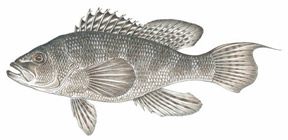 The black sea bass occurs along the Atlantic Coast of the United States from Cape Cod to Florida, reaching greatest abundance between the Capes of New Jersey and North Carolina. This species generally does not occur in the Gulf of Maine, but it is an important groundfish west and south of Cape Cod.
Black sea bass are fairly stout-bodied fish, with a long dorsal fin, and large pectoral and pelvic fins. The rounded tail sometimes has a long streamer trailing out from the top edge. Each gill cover has a flat spine near the outer edge. Mature males have a fleshy dorsal hump just anterior to the dorsal fin.
The background color of the black sea bass (smokey gray, brown, or bluish black) is mottled with darker patches and light speckles. The belly is only slightly lighter than the sides. The dorsal fin is marked with whitish mottling, while all other fins have dark spots, Young sea bass are green or brown with a dark lateral stripe running from the head to the tail.
The largest black sea bass caught by an angler in Massachusetts`s waters weighed 8 pounds. However, most adults do not exceed 1.5 pounds. A 12-inch fish generally weighs 1 pound, while an 18 to 20-inch fish weighs about 3 pounds.
Black sea bass have a very delicate white meat that is very comparable to filet of sole or codfish. Minimum size for a keeper black sea bass is 14 inches.
Tautog
 The tautog (or “tog”), a popular inshore game fish, has ranked as high as fourth in recent years in poundage taken by recreational anglers in Massachusetts. This species lives along the Atlantic coast from Nova Scotia to South Carolina, with the greatest number lying along inshore waters from southern Cape Cod to the Delaware Capes. It does not sustain a significant recreational fishery north of Massachusetts.
The tautog is a stout fish with a blunt nose and a thick-lipped mouth that has large conical teeth in front and flat crushing teeth in back. The single dorsal fin originates over the gill slit and runs back nearly to the tail. The anterior three-quarters of this fin possesses a series of stiff, sharp spines, and the paired pelvic fins have one spine each.
The color of the tautog’s dorsal area ranges from dark green to black, with these shades mottling a lighter background color of the sides. The belly is only slightly lighter than the sides. The white chin characteristic of large tautog has led to many anglers to call this fish the “white chin.”
Although capable of reaching large sizes, tautog are very slow growing. The largest tautog caught with hook-and-line in Massachusetts weighed 22 pounds 9 ounces. However, the average fish caught by anglers is 6 to 10 years old and weighs 2 to 4 pounds. Males typically grow faster and live longer than females. The maximum age for males appears to be about 35 years.
Both sexes mature at 3 or 4 years of age. The fecundity (number of eggs produced in a spawning season) of females is directly related to their size and weight. Female`s 12 inches long and 1 pound in weight produce about 30,000 eggs, while female`s 20 inches long and 5 pounds produce about 196,000 eggs per season.